Monday, March 28, 2011

TIA - This Is Africa

I am going to start writing things down that make us think the phrase ‘TIA’.  And I have a couple great stories to start out with.  A couple days ago while I was helping Sibo (what everyone calls Mariama - host mom #2) water her garden beds, I heard some loud noises in this huge Red Silk Cotton tree right by the garden. I look over at it and there is a family of about 5 -7 little red monkeys hanging out! I stopped watering and ran over there and got to watch them for a good hour (they were also watching me)!  They were very cute, climbing all over this huge tree, and one of them had a baby monkey on her stomach! As I was leaving to get my camera, our counterpart from the NGO KomFari arrived at the garden to talk to me so I couldn’t go get it but it was definitely a great ‘I live in Africa’ moment. I am sad Ben didn’t get to see it – he was working at the eco-camp that morning and by the time we got back to the garden, the monkeys had left.
There are a lot of TIA moments but I’ll just touch on one more. We are still eating with our family and yesterday, we had sting ray for lunch. Normally for lunch we have mashed up leaves on rice with some fish. See below...

This is what a normal lunch looks at on our site, and to be honest its not terrible.  For the ingredients available in village, our moms do a great job making things.  But this is where those care packages really are life savers, Thanks again so much!!! We both lost some weight during training so having protein bars, snacks, and the ability to cook has been a huge help to our health!  While we really want to be like our community – eating and living the same way, we have come to realize that it may not be in the best interest of anyone for us to eat only Gambian food because if we are sick all the time, we are no help to anyone.

A New World

Our first 2 weeks on site have been pretty great.  There is so much to say; I have filled up several pages of my journal each night it seems.  Because almost every day we discover something new about our family, village, or area.  I will try my best to convey what the past 2 weeks have been like for us, and apologize for the complete lack of organization (and perhaps too much detail) of which the following entries will most likely entail.  I want to say thanks for the emails, posts, and encouragement regarding the blog – it helps me find the time to write when I know people are enjoying reading about our experiences.
We are trying our best to take it slow and get to know the community before we start working on any projects as this is what the Peace Corps advises, but people in our village have expressed interest in many tasks so we have started a tree nursery at the school, a garden bed and 2 compost pits in the women’s garden. We also started an herb garden, tomatoes, and a compost pit in our backyard as well.  It feels great to have some things growing in the ground again, and they grow so fast here. Our herbs that we planted are basil, cilantro, oregano, and chives, and in the women’s garden we planted tomatoes, okra, cucumber, peppers, and egg plant – or as Gambians call it, garden egg.  
Having a bed in the womens garden is a daunting task for me because although I’m supposed to be teaching the women about gardening, I have all of 2 years experience gardening in my life, and not a single one in Africa -compared to the women here, who seemingly have had more gardens in their lifetime than I have in years!  Yoo, wo koleta (ok that is difficult!).  But I am coming to terms with the fact that yes my garden could fail, miserably.  But I am still hopeful about my garden techniques because I have seen some of the women spending lots of money on synthetic fertilizers and not using any compost or mulch, and others transplant their vegetables by yanking them out of their nursery beds – ouch! But again, I am trying to go slow, and concentrating hard on just observing and being there in the garden rather than trying to tell them how to do anything. I just show up every day, ready to water my bed and compost pits, help my host moms with theirs, and greet all the women. Because really it is a social time as well as work. And, it is beautiful there. Pictures soon to come for sure! Gardino ninyata (Garden is nice!).
 I’m working on trying to know our peoples names – another daunting task, as a common greeting here in the Gambia is calling out the person’s last name.  I am terrible with names; I think that I inherited it from both my parents (example, both my parents still call the ice cream store TCBY – TCYB, and when reading this will wonder if it is really called TCBY or if I am just kidding around – Love you Mom and Dad, but its true).  
But It doesn’t make it any easier when the villagers have names like ‘Hapu Buta’; I try to remember her by thinking her name is similar to happy birthday but then I just end up calling her Happy Buda and laughing at my ridiculousness.  It’s okay she’s about 7 and thinks it’s hilarious too.  And everyone knows our names for the most part, and we know about 10 people names (out of 300-400). Why can’t they have a village yearbook or something? ;)  Maybe that should be our 3 month challenge!

Our new house for 2 years! We'll get a better picture but our portion of the house is on the right side with the door open.

It’s Official

We are officially Peace Corps Volunteers as of March 11. We both passed our language tests and are no longer in training. We spent 10 days in the city area, which Gambians call ‘Kombo’ where we stayed with 28 other trainees in the Peace Corps transit house in the tourist area called Senegambia for 10 days and had a good time.  We attended Peace Corps sessions, relaxed at the beach, went out to eat, had a swearing ceremony, met other volunteers, and enjoyed other Americans company.  The transit house is a 5 minute walk to a nice beach, close to several restaurants, and a cab ride away from a huge market that sells everything! It was nice to be in a city for awhile after living in a small village for 2 months.  We tried to take full advantage of things like meat, pizza, electricity, showers, and going to the beach. However, we also had to prepare for our 3 month challenge at our site.  3 month challenge means that we try not to spend the night away from our site for 3 months – we may have to break this but not for more than a couple nights.  So we were busy in Kombo going shopping for things like a bed, plastic chairs, mats, food, and other materials that aren’t readily available in our village. Peace Corps provided us with transportation to the market 2 days in a row and we still didn’t get everything that we needed, but we got enough to hold us over until we could return to the city again.

Ambassadors backyard

Our swear-in ceremony was held at the U.S. ambassador’s house, right on the beach.  It was a nice ceremony that all of the trainees dressed up for.  We wore the Gambian traditional ‘Asoebe’. This is a style where people of the same compound (or family) wear the same fabric.  It is comparable in the U.S. to wedding ceremonies, where the bridesmaids and groomsmen wear the same fabric but different styles.  Gambians wear asoebes on important events and holidays.  All of our trainers also wore asoebes too, and they all looked fabulous! The ambassador, the Gambian Minister of Forestry, the Country Director of Peace Corps in the Gambia, and several volunteers gave speeches.  Then we enjoyed a brunch, and some of us jumped in the ocean with our Asoebes on.  Later in the day, the volunteers prepared a party for us at a bar called The Scottish Embassy.  The party was nice, relaxing, and we received some great food prepared by the other volunteers.  We had hamburgers, thai food, Indian food, and plenty of desserts as well as Gambia’s only microbrew called Julbrew. After the party we went out to the beach and enjoyed the night.
Us with our first language teacher and the other members of our training group - Sharon and Lina

Saturday, March 12, 2011

It’s not what you know, but who you know

Already in our short time here we have met some great people with some fascinating stories;  I just picked a few to write about for now:
Hanna – she is a 69 year old volunteer who has two PHD’s, served a full 2.5 years as a volunteer in Samoa last year. She started an exotic animal vet clinic in DC, and had 4 foster children and one adopted son.  Her foster daughter was a Bosnian refugee who now works full time in Tennessee. 
Jen – is from New Jersey and is a very talented designer.  Check out her awesome photos so far: Jen’s Photos. She is placed by the beach not too far from us and is going to work with a Non-Government Organization helping with radio, and design stuff. She’s also going to teach us how to use our camera!
Abby – was a Young Life leader in Georgia. She is placed out in the bush in Basse, UpperRiver region where it’s hot and life is hard! She is strong though, so she’ll do great. Example, Abby has been sick since we arrived. In fact, she has poo-ed her pants 4 times since she’s been in the Gambia.  The last time, she was climbing the stairs to use the toilet, tripped, and….well, the 4th time happened.  But, good news, Doctor Mike got her stool sample back today and she has a parasite. This is actually good news because she can take some pills and it will go way quickly! And she’s eating for two – her and her parasite!
Seth – grew up in a small logging town in Washington with 14 siblings. His dad is an ex FLDS, ex secret service agent for Nixon who has pinned Henry Kissinger to the wall, and currently believes WW3 is near. His dad is also convinced that the HBO series ‘Big Love’ is based on his life, and has been approached a number of times for reality TV series.  We are going to be given a signed copy of his dad’s book that is being edited for publishing. 
Mike – is from a small town in Oregon but acts like he’s from Texas so we get along pretty good. Mike shot himself in the leg with a revolver.  And that small town he’s from - just happens to be the same small town that a Mr. Steve Prefontaine is from! Mike has been in Pre’s mom’s house and helped her move boxes down from her attic. He said her attic is littered with Pre’s old awards and articles and such. He also said we could visit.
Ibrama S Bah – this is our current language instructor who is a very gifted teacher. He is a Gambian (a Fula) who knows a whole lot about Reggae music, and actually used to be a Rastafarian. He studied in the UK for about 9 months and told us a story we won’t forget for awhile: While studying in England, he decided to go to France to meet up with a Gambian friend.  He couldn’t get a hold of his friend so he tried to find other people that would house him for the night (all the hotels he could afford were booked already).  He did this by walking up to random people on the street and asking to stay with them, which is probably common in the Gambia where everyone knows everyone, but obviously in our western culture norms – that is not a common thing to do. So he ended up getting a trash can and putting it in a phone booth and sleeping inside the trash can. I think the best part was that the point he was making with this story, however, was NOT the fact that he slept in a trash can inside a phone booth but that it was really really cold that night.

Saturday, March 5, 2011

Site Visit

We made it to site visit! In January, we weren’t sure if we’d ever see the day but it finally arrived.  Currently, I am typing this inside our tent in our hut.  We set up our tent because our site visit is that survivor style trip I was talking about earlier where you don’t have a bed or any cooking utensils yet so to keep bugs off us while we sleep, we set up our tent inside J. (Yes, there are bugs in the bush in Africa – big surprise there). 
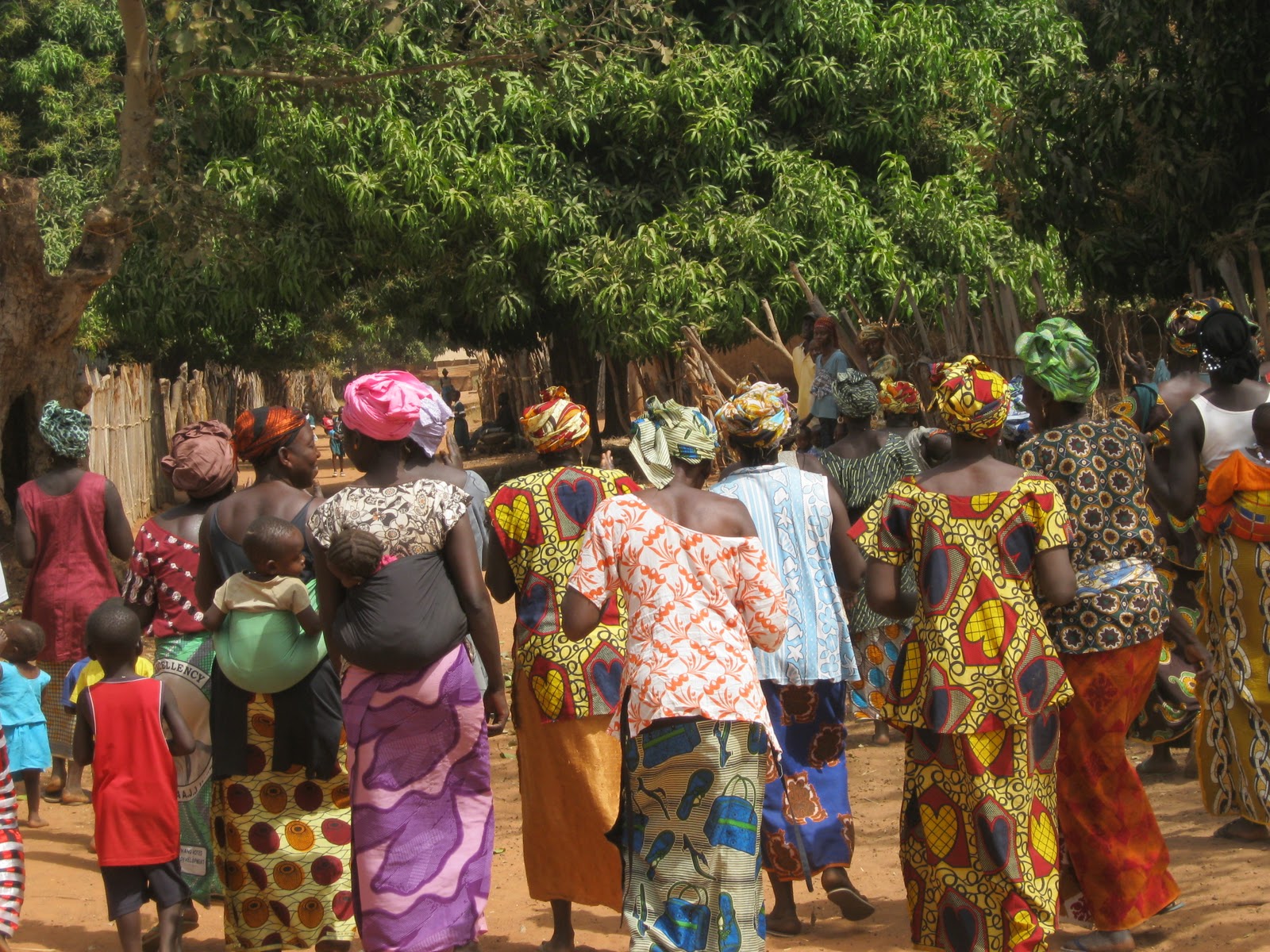
We had a great arrival to our site.  When we were driving up, the women started dancing and singing all around the car! It was great; they wouldn’t let the driver drive any faster so that they could dance in front of the vehicle. Then we got out and they kept dancing and singing and made us dance and we greeted everyone.  Luckily, our site mate that was with us got some great pictures for us! We like our site, very much. The people are nice, seem very hard working, and we are out in the bush but only an hour gely ride from a bigger city with internet and a large market.  The villages put in request for volunteers, and the Peace Corps reads them and accepts requests based on needs and skills of the volunteers.  It’s pretty neat, some volunteers had great stories of their village meetings thanking them so much for being there because they’d asked for an agriculture or health volunteer for so long and they were finally there.

The women dancing in front of our car

We went down by the river, and it is nice, big, and you can swim here because its close enough to the sea that it’s still salty (so no hippos, crocodiles, or freshwater parasites like you would find upriver).  Our host dad is a nice man who is a fisherman and speaks English! One of our host moms speaks English as well.  Yes we have two host moms.  Our host dad had his first wife and then took a second one when his brother died so our 2nd host mom is new to our village as well. We have a great mango tree in our yard that shades a nice big area of the compound. Our house is similar to our training house, but a little bit bigger. 
We met the manager of the eco-lodge that is a 2 minute walk from our house on the river.  The eco-lodge is neat, has 17 huts with toilets and showers in it.  Our village owns the lodge, and it looks like there are a lot of opportunities for work there.  They told us that a class from the University of Maryland came last year and is supposed to come again in May to do archeological digs.  The class found a human skull, old pottery, and other things that were left behind in the area.  The area by the river is an old slave trading spot.  It was featured in that movie Roots that we watched in High School (9th grade geography?).  They also told us that university classes in Norway, Sweden, and England have all come to the lodge as well for courses on music.  There is also a big women’s garden that a Spanish NGO has installed a solar pump in.  The solar pump is still being worked on, but it looks like it will be ready by the end of the dry season in June.  They are also putting in pipes throughout the garden so women can easily access the water.  It is great!  Now we are back in the city area for our final language test, more classes, and swear-in ceremony (which will be televised on Gambia’s only tv channel!).  
We leave for our site again on March 15 and are going to be doing a 3 month challenge.  That is a PC Gambia term for staying at our site for 3 months straight, and not totally involving ourselves in any major projects but getting to know our community and language sufficent enough so that after our 3 month challenge we can begin working on projects we feel would be a good fit.

Marathon March

It is a Peace Corps Gambia tradition that every training group go on a lengthy hike known as ‘marathon march’ towards the end of their training.  Our group was no exception.  It was fun, and the day of the hike was a success.  The day after….was not.   The hike was a 9 hour hike in the middle of nowhere Africa – with no lunch. We woke up at 6:30, got some bread, peanut butter and jam, and then found out we weren’t getting lunch so pc staff were there handing us hot boiled eggs while we were in the van saying ‘take it, you’re not going to be eating for a really really long time’.  Interesting way to start the day.  So we hiked all day through women’s gardens, salt flats, tall grasses, tall trees, and mangroves! Once we got to the mangroves we had to sift through muddy water until we reached a stream where we had to swim about 400 m, fully clothed and some (like my wonderful husband) with full packs on their heads.  While we were in the mangrove forest, someone commented that this is how they train Marines – and I noted that I didn’t sign up for the Marine Corps!  The swim was really refreshing after walking miles in the Africa heat – it’s starting to get hotter during the day now. Not terrible, but more like Texas in May than in April.  We walked a total of 24 k (about 15 miles) and arrived at a nice eco-lode with baboons, an awesome pool, and floating cabins on the water.  It was a nice finish but kind of a tease because we ate dinner, and then Peace Corps came and picked us up and took us back to training village. According to older volunteers, the marathon march ‘back in the day’ entailed Peace Corps dropping people off in boats and telling them to find their way back. ha – so I guess we shouldn’t complain?
The day after was pretty awful.  We were served lunch, and dinner the days previous to going on marathon march by a guy named Omar that the peace corps likes to have cater.  And everyone ate it up because Omar cooks some semi-western dishes and we are all very hungry for food that doesn’t have rice involved with it! Well, the morning of marathon march we had 7 people sick but some still went on the hike.  The day after marathon march, 6 more people got sick with food poisoning and had to go to the med unit.  That was half our training group; it was scary! Luckily, Ben and I were spared this time!

                                                 The Baobob trees are fantastic in The Gambia!

Friday, March 4, 2011

More Pictures

Our whole host family in training village!

Our compound - our room was the last door on the left.

Womens community garden in Training Village - so big and great!

Some of the women at work