Saturday, March 5, 2011

Site Visit

We made it to site visit! In January, we weren’t sure if we’d ever see the day but it finally arrived.  Currently, I am typing this inside our tent in our hut.  We set up our tent because our site visit is that survivor style trip I was talking about earlier where you don’t have a bed or any cooking utensils yet so to keep bugs off us while we sleep, we set up our tent inside J. (Yes, there are bugs in the bush in Africa – big surprise there). 
We had a great arrival to our site.  When we were driving up, the women started dancing and singing all around the car! It was great; they wouldn’t let the driver drive any faster so that they could dance in front of the vehicle. Then we got out and they kept dancing and singing and made us dance and we greeted everyone.  Luckily, our site mate that was with us got some great pictures for us! We like our site, very much. The people are nice, seem very hard working, and we are out in the bush but only an hour gely ride from a bigger city with internet and a large market.  The villages put in request for volunteers, and the Peace Corps reads them and accepts requests based on needs and skills of the volunteers.  It’s pretty neat, some volunteers had great stories of their village meetings thanking them so much for being there because they’d asked for an agriculture or health volunteer for so long and they were finally there.
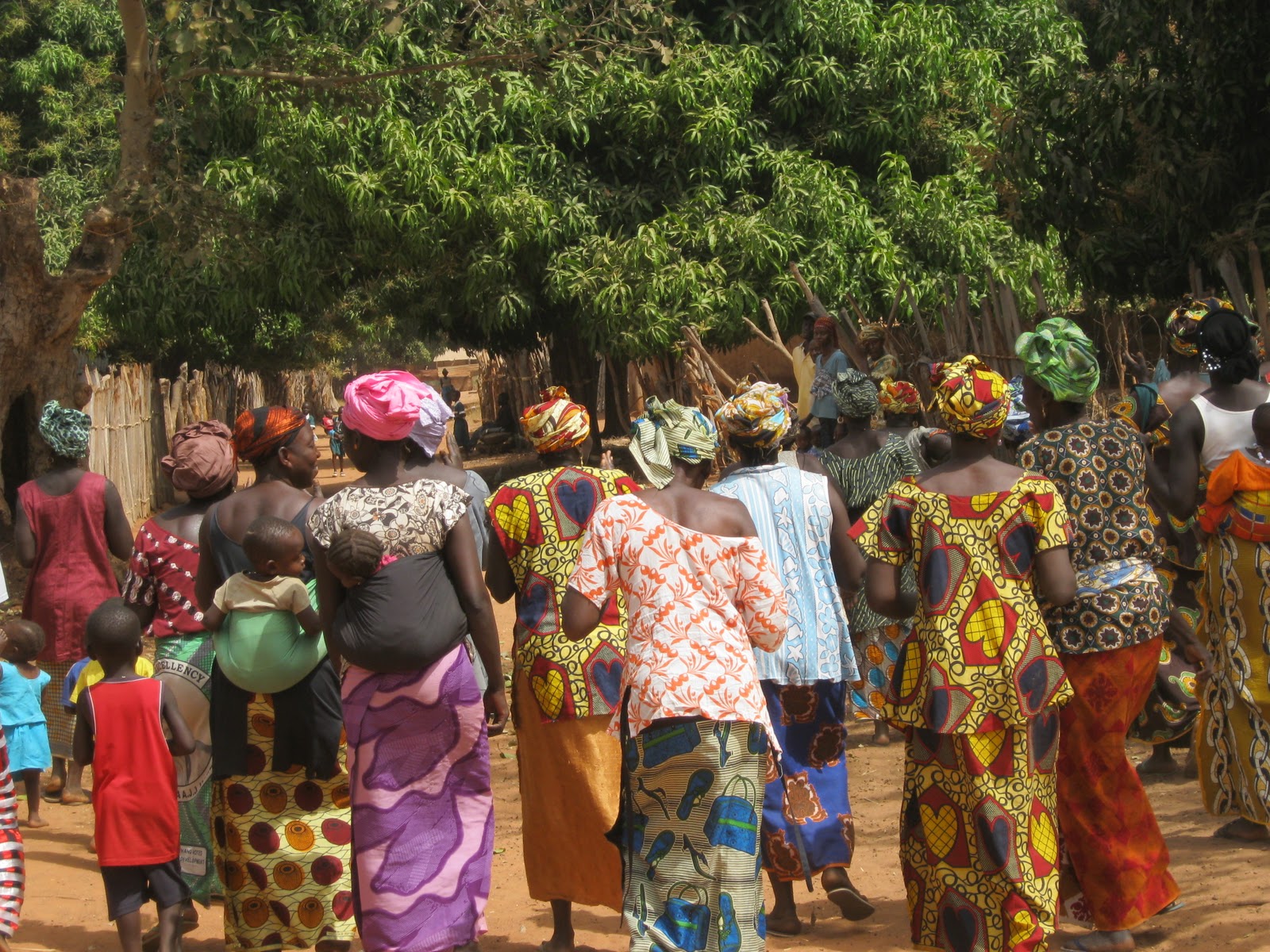
The women dancing in front of our car

We went down by the river, and it is nice, big, and you can swim here because its close enough to the sea that it’s still salty (so no hippos, crocodiles, or freshwater parasites like you would find upriver).  Our host dad is a nice man who is a fisherman and speaks English! One of our host moms speaks English as well.  Yes we have two host moms.  Our host dad had his first wife and then took a second one when his brother died so our 2nd host mom is new to our village as well. We have a great mango tree in our yard that shades a nice big area of the compound. Our house is similar to our training house, but a little bit bigger. 
We met the manager of the eco-lodge that is a 2 minute walk from our house on the river.  The eco-lodge is neat, has 17 huts with toilets and showers in it.  Our village owns the lodge, and it looks like there are a lot of opportunities for work there.  They told us that a class from the University of Maryland came last year and is supposed to come again in May to do archeological digs.  The class found a human skull, old pottery, and other things that were left behind in the area.  The area by the river is an old slave trading spot.  It was featured in that movie Roots that we watched in High School (9th grade geography?).  They also told us that university classes in Norway, Sweden, and England have all come to the lodge as well for courses on music.  There is also a big women’s garden that a Spanish NGO has installed a solar pump in.  The solar pump is still being worked on, but it looks like it will be ready by the end of the dry season in June.  They are also putting in pipes throughout the garden so women can easily access the water.  It is great!  Now we are back in the city area for our final language test, more classes, and swear-in ceremony (which will be televised on Gambia’s only tv channel!).  
We leave for our site again on March 15 and are going to be doing a 3 month challenge.  That is a PC Gambia term for staying at our site for 3 months straight, and not totally involving ourselves in any major projects but getting to know our community and language sufficent enough so that after our 3 month challenge we can begin working on projects we feel would be a good fit.

Marathon March

It is a Peace Corps Gambia tradition that every training group go on a lengthy hike known as ‘marathon march’ towards the end of their training.  Our group was no exception.  It was fun, and the day of the hike was a success.  The day after….was not.   The hike was a 9 hour hike in the middle of nowhere Africa – with no lunch. We woke up at 6:30, got some bread, peanut butter and jam, and then found out we weren’t getting lunch so pc staff were there handing us hot boiled eggs while we were in the van saying ‘take it, you’re not going to be eating for a really really long time’.  Interesting way to start the day.  So we hiked all day through women’s gardens, salt flats, tall grasses, tall trees, and mangroves! Once we got to the mangroves we had to sift through muddy water until we reached a stream where we had to swim about 400 m, fully clothed and some (like my wonderful husband) with full packs on their heads.  While we were in the mangrove forest, someone commented that this is how they train Marines – and I noted that I didn’t sign up for the Marine Corps!  The swim was really refreshing after walking miles in the Africa heat – it’s starting to get hotter during the day now. Not terrible, but more like Texas in May than in April.  We walked a total of 24 k (about 15 miles) and arrived at a nice eco-lode with baboons, an awesome pool, and floating cabins on the water.  It was a nice finish but kind of a tease because we ate dinner, and then Peace Corps came and picked us up and took us back to training village. According to older volunteers, the marathon march ‘back in the day’ entailed Peace Corps dropping people off in boats and telling them to find their way back. ha – so I guess we shouldn’t complain?
The day after was pretty awful.  We were served lunch, and dinner the days previous to going on marathon march by a guy named Omar that the peace corps likes to have cater.  And everyone ate it up because Omar cooks some semi-western dishes and we are all very hungry for food that doesn’t have rice involved with it! Well, the morning of marathon march we had 7 people sick but some still went on the hike.  The day after marathon march, 6 more people got sick with food poisoning and had to go to the med unit.  That was half our training group; it was scary! Luckily, Ben and I were spared this time!

                                                 The Baobob trees are fantastic in The Gambia!

Friday, March 4, 2011

More Pictures

Our whole host family in training village!

Our compound - our room was the last door on the left.

Womens community garden in Training Village - so big and great!

Some of the women at work

Pictures

We are almost finished with training and are in the city area for 10 days. Which means we finally have time to upload pictures! Here are a few pictures we took during training – we really didn’t have time to take that many so hopefully we’ll get much better ones at site.

This is a picture of the trainees at our naming ceremony in Training Village

Ben and I on our marathon march!

Our Host mom and my namesake: Caddy Gitteh with Aminata


Wednesday, February 23, 2011

Cultural Exchanges - 18 Feb 2011

During our training, we’ve been learning a lot about Gambians values, beliefs, and suspicions.  They have a lot of superstitions, as we do.  Gambians believe that if you sweep at night or whistle at night you will have bad luck. They also believe if you touch your head, you will have bad luck. If you wear scripture around your body, you will have good luck.  Gambians believe in greetings – Peace be with you, how are your people, how are the children, how is your father, how is your mother, etc.  We are not fully used to it yet, but it is the way that Gambians show they care about you.  They ask you where you’re going, where you’ve been, what you’re doing tomorrow, etc.  When ben and I are separated, it is Sana lee? (ben where?) from everyone who walks by. Gambians also believe in sharing, especially food.  Everyone asks you to eat with them, but we are being fed by the Peace Corps right now so we decline.  When our host dad goes to another town, he frequently picks up something for us – an ice-y, fanta, sweet bread.  He is a fabulous host dad. Last night, a few of the trainees in our village gathered together to eat cookies and look at the full moon (forms of nighttime entertainment are few in the village).  Our host dad told us that he would not go to sleep until we came back, and sure enough upon our return he was still sitting on the front porch waiting. J It is odd for us to have a curfew again.
We also entertain the children.  All of the volunteers have different methods for this. Some play a version of duck duck goose (baa baa sisi - english translation: goat goat chicken), some come up with insults in mandinka (?), some teach english while learning mandinka, and some just scare them all. We have come up with different methods, its challenging when you can’t fully speak the same language! It’s hard to explain red rover and simon says so I’ve stuck to ‘patty cake’ and started having our kids do races.  They love both.  Patty cake is funny because random kids will do 'air' patty cake to me from across fields, gardens, and compounds.  Racing is fun because they look so dang cute and everybody loves it.  We make them hop, jump, bear crawl, crab walk, etc. Any other ideas of things to entertain children with would be welcome!

Transportation and Clothing

Transportation in the Gambia is interesting. The most common form is a van/bus type of thing called a Gely. These come sporadically during the day and are big vans that try to fit as many people as possible inside them before departing for the destination. It is actually a really great example of the difference between our cultures.  We will be on the Gely, getting figidty, asking the driver 'when will the bus leave?'.  The african driver will say, when it is full of course!  Our views of time are Oh so different!
It is also common to see goats and chickens riding on top of the Gelys.  There are pick up spots and drop off spots around the frequently visited areas such as the big markets. Here is a description of how we get to the Peace Corps office on public transport from our training village: We take a gely from our village to the stop light (there are a total of 8 -9 stop lights in Gambia, so people know what stop light you are referring to), next we get a yellow cab that is going in the direction of the office.  You have to get cabs going in the same direction you are going or you pay 5 times the normal price. Then we get dropped off in front of the office.  To go back is trickier. You get a cab to ‘Westfield’ then you get another cab to ‘Tipa Garage’ and then you get on the Gely back to our village. Last time I was with another trainee and we saw Bah2 - a member of our peace corps staff who works with the environmental group.  He came over and helped us get to where we needed to be.  Later we saw a neighbor in the Gely who yelled for us to get in, so that was neat.  And when we tried to get out too early, she stopped us and made us get out at the right stop. Can’t say that Gambians don’t look out for us toubabs! The total cost of a trip from our training village to the Peace Corps office, about 50 dalaisi – less than 2 dollars.
Clothing
People here don’t really go out and buy clothes.  There are places in the big cities where you can buy goodwill European clothes but they’re usually too expensive for villagers.  Villagers buy fabric and have clothes made by tailors.  It’s really great.  Ben is enjoying it a lot because he can get shirts that fit him well.  He also enjoys wearing pajama-like outfits all day. I really like it too, but women are expected to wear long skirts.  The tailors in the big cities are pretty good and they can make anything if you give them an example. And it’s pretty cheap too.  We both plan on taking full advantage of it once we settle into our site!  So if anybody has any old magazines with cute clothes – send them our way J.  Last night, on our way to meet up with some peace corps friends, a Gambian man starts talking to us and following us.  We are both confused and not sure what to think about this, more than sketchy situation, when the Gambian starts speaking English and says ‘Hello, it’s me, your tailor!’. He then says, “Sana (Ben), I need to talk to you about your tailoring needs”.  He had tracked us down to talk to ben about an outfit he’s getting made for our swear-in ceremony! We got it all straightened out but neither of us had ever in our lives had someone track us down for our 'tailoring needs'.

Training Continued - 13 Feb 2011

Hello friends, we have internet connection….for a day at least! We are in the city area for a workshop tomorrow and a long hike (20 km), known as Marathon March.  
We are still busy with training, and over the past few weeks our training has consisted of interesting things like tree nurseries, orchards, integrated pest management, bee keeping, and mud stove building.  One day we got to visit a random Gambians house who had a pretty nice orchard consisting of a variety of citrus (lime, grapefruit, oranges, and sweet lemons), mangos, bananas, and cashews.  This is very unique for the Gambia, most people have a few mangos and oranges but don’t maintain them much.  This guy lived in France for awhile and brought back practices he saw there.  He had different varieties of citrus that have different harvest times than the rest of the citrus trees here so he makes a pretty penny.  And, of course, the fruit was amazing!  He also raised pigs, chickens, and had a small garden started.   It was great to see this type of small scale, polycluture type of agriculture being used here. I don’t think any of us wanted to leave; the free oranges were too delicious!
Last week, our training group split up into environmental and health sections and went on separate field trips.  The environmental group took a trip east, up the river to an island called Georgetown.  We stayed in a nice lodging with toilets and a shower – after you live in a small village in Africa for a while your definition of what is nice is altered a bit.  All of us trainees are starting to feel our definition of nice and ‘good food’ being completely changed!   On our field trip, we visited an aquaculture facility and a horse & donkey trust run by some nice British folks.  The aquaculture facility was very large and offers free tilapia fingerlings to pc volunteers.  This is good and it may be something our community will want to pursue since we are right on the river.  The horse & donkey trust takes in injured animals and nurses them back to health; they also teach locals how to properly treat their animals.  Now Ben wants to purchase a horse, but I’m not convinced. Too expensive – even in Africa!
The landscape of the ‘central river region’ of Gambia looked a whole lot like parts of central Texas – semiarid grassland. The climate was drier and hotter than our training village which is in the western region (the same region our permanent site will be). This was the part of the country where lions used to roam, but not anymore. We saw some beautiful birds, more lizards, and probably everyone’s favorite part of the trip….monkeys.  The first monkey we saw was by himself walking along the road, and that was cool but then a few hours later we saw a ‘herd’ of baboons (there had to be about 50) being chased by an African with a machete and a dog! The whole bus erupted with monkey sounds too, it was pretty great. I even got a picture!  Apparently this region has a baboon problem.  They eat their crops and are mean monkeys! They beat up dogs and such. Gambians have a proverb for that (and a whole lot of other things) – The monkey and the dog will never get along.