Tuesday, July 24, 2012

Kaddy Getuh’s Library and Resource Center Open!

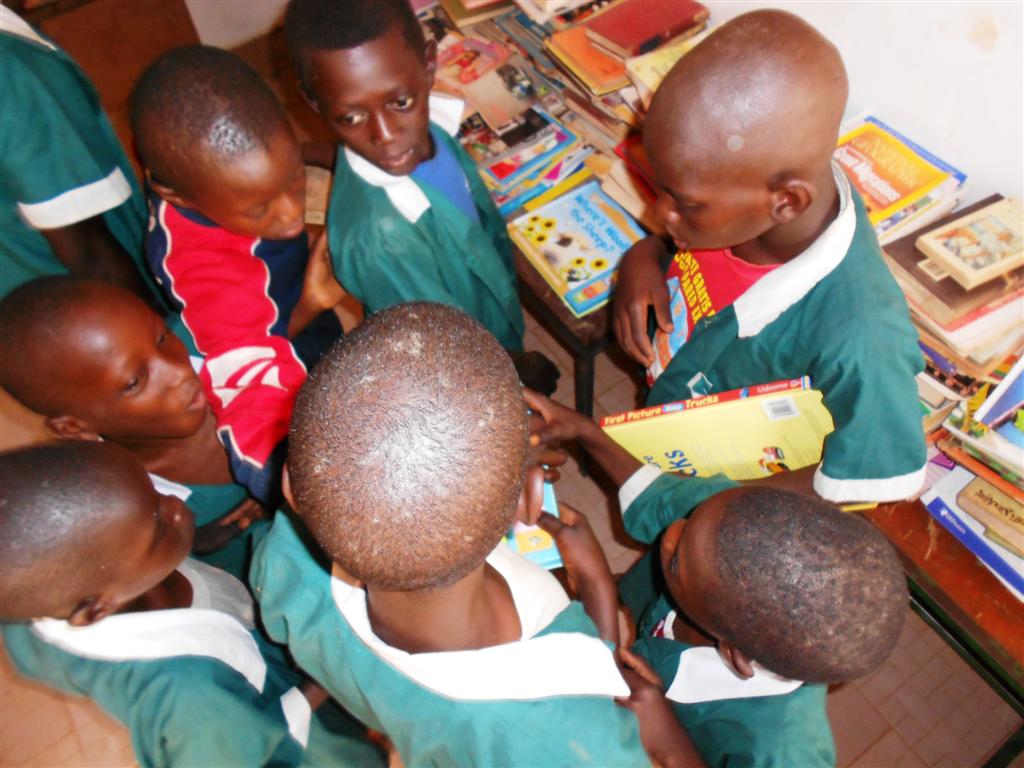
It seems that all my projects are wrapping up nicely and came about in the span of these last 2 months.  The first one of these was the library project at our school.  It was finished, painted, and opened right at the end of the school year.  I asked our site mate Jessica to come down and talk to the head master and help us organize the library. Jessica has worked on a couple different libraries in her service and she helped us catalog and sort out our 750 books.  We organized the books by easy picture books, medium picture books, advanced fiction, non-fiction, textbooks, magazines and teacher resources.  Jessica also suggested having a volunteer from the village run the library instead of a teacher.  The head master took her suggestion and it is going well so far.  The kids seem to really like the library.  When I’m there kids ask me about pictures, words, and a few like to hear me read.  Especially Dr. Seuss’s ‘One Fish Two Fish Red Fish Blue Fish’ which they call ‘fish fish fish’.
We color coded all the books by sections and the students and teachers both seem to be getting the hang of putting books back according to color. Thanks to everyone who sent books, they are being put to good use!
Students help to clean up


World Food Program Trek

In June, I had the opportunity to help another volunteer coordinate a trek across the country with World Food Program (WFP) and the Ministry of Agriculture.  The trek was to train head gardeners in schools participating in the WFP school garden program.  WFP provides schools with fencing, tools, seeds, training, and books.  This trek went to all 5 regions in the Gambia where we trained participants on the following: garden prep, composting, Moringa, live fencing, incorporating the garden into lesson plans, nutrition in the garden, pest control, action plans, and record keeping.  I helped co-manage the trek which entailed teaching sessions, distributing per diems, keeping time, and coordinating the guest lectures. The trek was two days at each region and lasted 10 days.  It was a lot of fun seeing the whole country and hanging out with volunteers I don’t normally get to see at site, but afterwards I was completely exhausted!


The sessions I led were on Moringa, live fencing, and incorporating the garden into lesson plans.  Another more informal task I had was to keep my Gambian counterparts on subject.  Most Gambians are gifted speakers and can talk at length about any subject at anytime, and are often more than willing to do so.  This can often allow speakers to get completely off topic and go on for any amount of time given.  I had to constantly remind speakers to remain on topic and of time restraints.  To give good examples of this, I kept a list of quotes that were said at some point during our 10 day trek:
This is the worldwide web. Nobody would be mad enough to put something untrue on here!
All work and no play make jack a nonsensical girl….or boy.
Hunger is a 3rd religion challenging Christianity and Islam – and football too, is challenging.
We dissolved 4 cubes of jumbo (a bouillon cube) in water and a donkey drank it and was immediately castrated.
Pest control lesson: You can use birds to peck insects.
Spain is going. Greece is gone. France is going down! You will all have to be farmers.
To drink cold water is bad for your diet, but hot water is okay.
Using a rake can increase children’s ‘Psycho Moto’ Skills.
Inexplicably hostile live fencing argument: There is nothing more beautiful than watching a tree grow.
You can’t make this stuff up!
My favorite story from the trek was when I went to see how the bed preparation was going and found my counterpart and participants chopping down a tree.  I arrived at the moment where the tree was falling and watched about 5 grown men dive out of the way.  I said, “Mr.Barry, Why?!” and he responds quite passionately, “We need the seeds Kaddy! They will take them back and they will plant them!” 
Mr.Barry avidly teaching garden bed preparation

Ben Blog

Soooo its time for another Ben Blog.  I’m sure you all have missed me since my last blog and been patiently waiting.  There have been some ups and downs over the last few months so I will just fill everyone in on a few of the things.
First of all, beekeeping season is over. I know, I know, very sad.  The season ends when the bees hunker down for the rainy season and stop making honey.   Luis (who is the boss of the beekeeping) wanted to wait until the people who paid for the project came here to harvest so they could participate.  They came at the end of June and we spent a few days harvesting.  Unfortunately things did not go great.  The bees behaved themselves and everything.  The main issue was that there wasn’t as much honey as we were hoping for.  So when we were going to get the honey I had to gather the village folk who were supposed to help us.  After gathering them up we sat around waiting for some kids to bring the donkey in from the bush.  We needed the donkey to transport the honey.  That only took an hour or so.  We finally got out to the boxes.  Did the harvesting thing and returned to a donkey cart WITH NO DONKEY! After all the waiting around to get the donkey, the donkey apparently had to go home before we were done harvesting the honey.  I was unaware the donkey had a curfew but apparently it did.  Luckily we had a team of donkey cart pulling small boys and solved that problem.  Anyway, when we finished with everything we noticed that we did not have nearly as much honey as last year.  The Spanish beekeeper guy who was here helping suspect (based on experience in Spain) that thanks to a poor rainy season last year we had a poor flowering season this year and had poor honey production.  I confirmed that honey production was poor in other places around the country with a beekeeping friend who spends a lot of time going around the country with his NGO helping beekeepers.  So I guess in the end that was a little disappointing.  The good news is that so far this has been a really good (really rainy) rainy season so hopefully that will mean they will get a lot of honey next year.
In other news of Luis he successfully had a marabou (traditional healer/witch doctor) fix his little problem of having a bad juju (curse) put on his farm from a guy he fired…close call right!  Luis has a “farm” he is constructing.  It involves a lot of concrete walls.  He suspected the guy in charge was stealing bags of concrete and selling them on the side to people in the village so he fired that guy.  I assume some other people in the village informed him that this man then put a curse on him and his farm and that he needed to see the local marabou to reverse the curse.  Like a good Spanish-African he did what he was told.  Based on the fact that nothing terrible has happened to him I guess it worked.  After the marabou did whatever it is he does he told Luis that he had to give charity (this is normal) and he had to cook some specific amount of rice and kill a duck or two and feed people.  We were around at the time of the charity so we go to attend.  The funny part that I noticed was that the people who attended the small charity meal were the very same people that Luis suspected of buying, at a discounted price, the stolen concrete and had been using it to construct a wall at their own compound. EVERYONE’S A WINNER!
Finally, sadly, my tie-and-dye project is finished and it was a pretty disappointing finale.  Here is the basic story of how things unfolded.  When we first came to village there was a compound run by a Women’s Health NGO called Bafrow.  In the year and a half we have lived in the village we have never seen them do anything.  The facility was a really nice phone charging station.  I think the real story is that they had some funding issues and had to put a stop on their program.  I will give Bafrow credit for being the organization who gave the initial tie-and-dye training that helped kick off my project but they also get credit for killing it.  If you will recall from my blog about this group that there were a few women making and selling dyed fabrics in the village.  Those women had been trained through Bafrow’s project a few years back.  We (me and 32 women) then started the group I had been working with for the last 10 month.  The entire project was funded by start up cash that these women put up last year and we were doing quite well.  The group was working on registering with the government, we were about to invest in some of the materials necessary to make more kinds of tie-and-dye and it was going really well…then Bafrow returned.  They came back to restart their project.  The women told them they had been doing tie-and-dye and Bafrow said great, they could help.  When I went to the compound I saw that they, the Bafrow people, had purchased and brought a bunch of the materials used for dying.  I was a little worried because it looked like they were giving the women a bunch of the stuff that I had worked to get the women to buy themselves.  So I went to the women running the project and asked what their plan was with their project.  They explained that this was not a new project; they were continuing a project they have been doing for 10 years (even though they haven’t been there for the last year and a half).  It took some explaining to get them to understand that the current tie-and-dye group was not a continuation of their project but something we set up ourselves.  My pitch to them was that it was great they were there.  We would welcome training and even some help with materials but they had to understand that these 32 women had made a financial commitment to our group and the work of that group needed to be treated separately from the Bafrow project which is for all the women of the village.  After some confusing discussion they decided that this was not possible for them.  Again, they were not starting a new project that had any obligation to work with my project.  They were continuing a project for all the women of the village that has been there for 10 years.  After that unsuccessful meeting I knew things were not going to go my way.  I had to call a meeting for my women and explain the situation.  We could continue our project, do all the same things and keep working but it was completely separate from what Bafrow was doing.   We would still have to invest the money in materials needed to continue on our own.  In the end the group decided that they should work with the Bafrow project because it was for all the women of the village and (I agree) there isn’t really a lot of room in a village of 250 (mostly kids) for two projects to make and sell tie-and-dye so we shut it down.  I don’t really blame the women who made that decision.  They just did what they thought seemed right and I didn’t expect to be able to compete with an NGO giving away free materials when I was always asking them to invest their own money.  In the end each woman who put in 150 dalasi last summer is going to get about 700 dalasis once all the money is collected so that’s good I guess.
Those are pretty much the highlights of my recent past here in The Gambia.  That and as soon as I get my hands on it I will be finished with all the currently published books in the Song of Fire and Ice (Game of Thrones for you Americans who don’t/can’t read) series.  If you want to talk about Jon Snow and the war in Westeros call me.
Ben's Game of Thrones reading being interrupted by Adama, Howa and Fatou. 

Wednesday, May 2, 2012

Tying and Dying

I thought it would be a good time to write a Ben post and let those of you who are anxiously waiting know how my work with the women’s tie-dye (henceforth known as tie and dye) group is going.  As you might have expected from a genius of my caliber, we have had a 400% increase in our assets since we started about 8 months ago.  After simply helping a few women last fall figure out how much money they actually make from doing tie and dye work they came to me and wanted to form a Kafo (group).  We sat down and figured out how many women wanted to be in the group, figured out how much our first job would cost and split that up evenly and got started.  Our first three jobs just involved dying fabrics and solid colors and selling those.  Our last job was our first batik job.  The best I can and will explain batik is that you go through a slow process involving a lot of dye and wax and make up designs and multi-colored fabrics.  Those are the fancy ones and cost a little more. 

finished batik

Last week three of the women, as well as Kate and myself, went over to a neighboring village to figure out this batik.  Two of the women had previously had training so knew what they were doing.  Nya Nya, Kate and I didn’t really know so we did a good deal of “helping”/watching.  The village we went to is home of the district training center (fancy name for phone charging compound) and they have a really good community development coordinator named Seedey Sey.  Seedey and a few women from that village really know what they were doing in terms of making batik so they definitely took the lead.  It was a pretty productive two days for sure.  We got all the work done and gained a good deal of knowledge as to what we can do with our little Kafoo.  I said Seedey is really good for one main reason at this point.  I talked to him when we were there less than a week ago about registering our Kafo.  He explained to me the details and the process and said he would help do everything.  Generally speaking here in Gambia, that would mean he may help eventually if at all. 

Within a week, and without any effort on my part he scheduled a meeting to come out to our village and go through the entire constitution writing process to get things going.  So we had that meeting, which took a good few hours.  We worked out the goals of the Kafo, the rules of the Kafo and the women have been assigned to discuss who they want to make the officers.  In the mean time we are finishing up those batik fabrics and they should be sold off here in a few days.  The biggest hassle of this project is collecting money.  Everyone here buys everything on “credit”…I will take it now and you can hunt me down for the money later.  It’s like America.  I think I have somewhat become the enforcer, which means I am constantly reminding people to pay.  The women take the request well and sometimes reminding them actually gets a few to pay here or there.  Once we have a little more cash we will move on to the next job and make some more fabrics.  Soon enough we will be registered, have a bank account, have cash to expand the work we do and be eligible for women in the group to get trained through the community training center in other things, including business management.    That’s pretty much it.  Hopefully a few pictures of batik fabric accompany this blog and more importantly.  I have some fabric for sale…batik is 800D, plain is 600D, everything comes as a 5 meter piece.  We accept no major credit cards or checks and shipping is not included (no guarantee item will successfully ship).  Email with orders and allow up to two weeks for reply. Thanks.

dyeing the fabric


working under the mango tree


Library and Resource Center

The work on Berefet’s newest and only library is almost complete.  We received the money from FROGS and started work before I left for Senegal.  Upon my return, the mason work was completed!  The project went extremely well, with receipts and all money accounted for.  There are horror stories of working with Gambian contractors and village workers to complete building projects and I was extremely happy that it went so well.  FROGS executive director, Sally Reader, came out to see the work on Thursday and she was very pleased too.  The teachers and students made several signs and held them up for her and her husband upon their arrival.  They all chanted ‘welcome, welcome’ and it was a lot of fun for everyone.
 The next phase will be to replace the roofing, paint, build shelves and desks, and buy large mats to put on the floor.  And then my real work will begin of managing, and teaching a Gambian how to manage a small library.  And thanks again to those who have sent or are sending us books! They are often the best ones the school has, and people here really do enjoy looking at / reading them.  And know that people here do enjoy your gifts and your generosity is appreciated.

Fixing the House


Mason work completed, its Nice!

Thank you!

Taking the books out of the closets


Waiting for Sally outside the gate


Welcoming Sally

Another unanticipated activity I’ve been doing at the school recently has been helping the kitchen ladies fix some food sent to us from America!  My friend Lauren Grayson, and her middle school students from Irving Texas, sent our school a large box full of mac & cheese, ramen, and other food they raised together at their school.  We had days where I would help prepare the food for the school.  They were all happy to eat food from America! It was a lot of fun and some of the kids really liked the food while others…not so much.  Thanks again Lauren!


Eating Mac n Cheese


Biggest pot of Ramen noodles I've ever seen


She liked it.

Changes

While I was in Senegal, a couple of changes occurred for us in village.  First, our host mom, Mariama-Sibou, moved back to the city taking Yaya, her baby, and Al San, our favorite kid in the compound.  Her sister moved to Spain and asked Sibou to take care of the compound in her absence (which could be for the rest of her life).  Sibou told me before I left for Senegal but I was hoping to be back before she officially left.  Although strange for American culture, this is a fairly normal thing here.  While this is very sad for us, Sibou is much happier living there as she is not expected to work the farm, garden, fetch water, and cook three meals a day at the same time.  Her tasks now include cooking meals and cleaning.  She also is selling a local tea called Wonjo.  We visited her new compound last weekend and found her very happy and quite well off  by Gambian standards.  She made us a delicious chicken benechin lunch and we drank cold wonjo afterwards! That type of lunch was impossible for her to provide in village, so it was really nice for us to be able to do that with her.  The worst part was when we were leaving, she and the children walked us to the road and I carried Al San on my back.  When they had to stop, I put Al San down and he started bawling.  Although there are still lots of children in our village and compound, we will miss the little guy too.
The other change is similar. Our counterpart who helped us with anything in the village, Ebrima-Solo, also moved out of the village while I was in Senegal. He too had been planning to move to the city to find a job, but a large village fight set him off and he decided to move quicker than he had planned.   This is what happened:  Ebrima and I had been working on a food security grant for a village tree nursery and to cap the open well adjacent to the future nursery spot.  The tree nursery was going to be on the compound designated as the Youth Association building that we cleaned up last October.  However, while I was in Senegal, the Imam who lives in the neighboring compound built a 7 foot cement wall around the area, taking the Youth building and land as his own and cutting down the trees there (that did not belong to him either).  Ben saw this and told Ebrima that if the Imam owns this land then our grant will be canceled.  There was a village meeting in which everyone yelled at each other and blamed Ebrima for not telling the village our plans.  Ebrima had asked the village leader (the Alkalo) twice about the nursery plans and gotten the OK both times.  Likewise, the whole village saw the Youth Association working on the compound last October and previous months and were acutely aware of the nice lock Ben and I had donated to lock the door of the Youth building.  Never less, the fight caused Ebrima to move sooner than later before I came back from Senegal.  We also visited him, and it was evident that he was still quite stressed about the fight.  He told us that the forestry department had come to our village and reprimanded the Imam for cutting the trees and said the Imam does not own this land that it is in fact the governments land, but Ebrima did not know if any actions would be taken against the Imam.  Now, Ebrima is focusing his efforts to get a job in order to pay for his schooling.  Another friend we are sad to see leave the village, but happy he is trying hard to go back to school.   As Gambians say “It’s not easy, man” but “we are managing, you know” J.

Excuses why we haven’t blogged in awhile…

This past month we have been going up and down again.  We joined our site mate Jessica on a bike ride from our sites in Foni to the coast as south as you can go to Kartong.  Kartong is a really pretty little beach town where we met up with other volunteers and spent a couple nights at a lodge on the beach.  The bike ride took us 7 hours and was not easy, but fun.  We made some stops along the way, one involved getting ice from a random compound and another involved someone using a local toilet which is a story you’d rather not hear about.  As usual we had fun hanging out with friends and eating delicious (non rice based) food.  The lodge we stayed at is known as a ‘tree house’ lodge.  This name is misleading as the ‘tree houses’ are really just huts on stilts consisting of concrete blocks so I wouldn’t necessarily think of them as tree houses per say, but you are not sleeping  directly on the ground which is more like a tree, and also a lot scarier.  And the real clench is that it only costs 10 USD a night to stay in a tree house, which does not make it any less scary but does fall within our Peace Corps budget.

Our Tree House


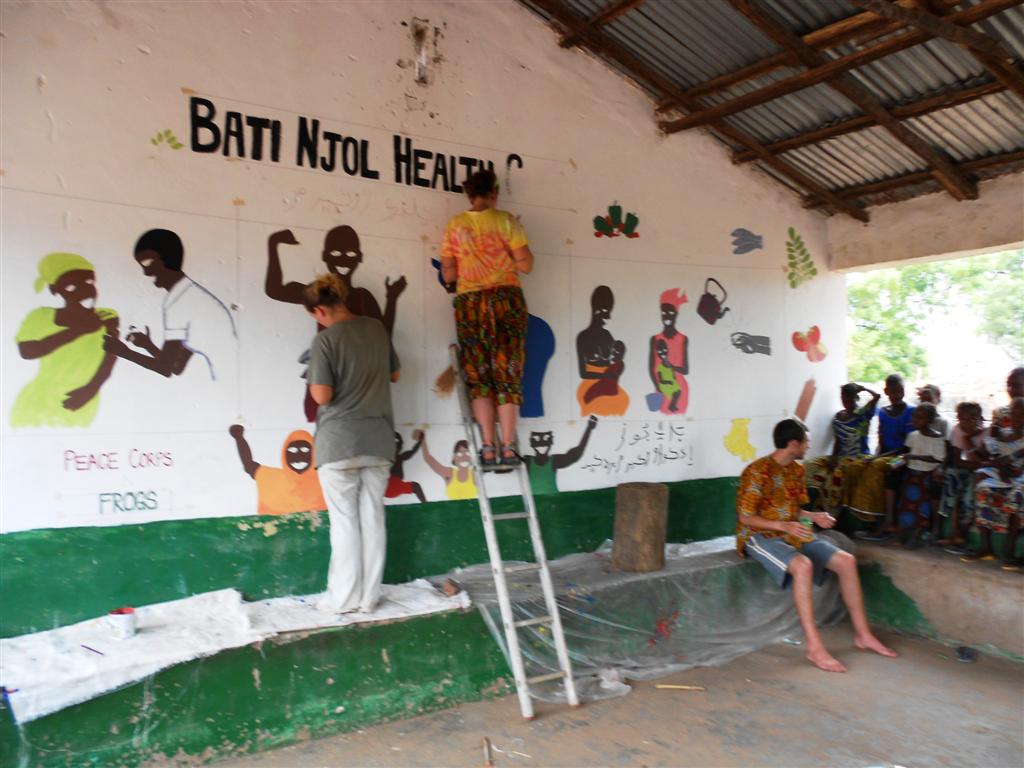
A couple weeks back, we went to another volunteer’s site up country to help her paint a health mural on her women’s clinic building.  Her village is a wolof village and very different from our mandinka/jola village.  To us, they seem much more relaxed, have horses, grass roofs, and most importantly they eat coos more than rice.  And coos is good! It is hotter there but while we were there we had a fluke rain which made it awesome.

Walking through Shawn's village

Painting the health mural with an audience

Shawn painted herself in the mural

Road to Shawn's village

 However, rain in March is a strange phenomenon that hasn’t happened for at least 7 years we were told.  Inshallah, this means we will have a strong rainy season this year.  Last year’s rain was not enough causing harvest yields across the country to be down about 50 percent from the year before.  Department of Agriculture is asking the international community for food aid this year because of last year’s poor harvest. 
I also volunteered to help lead sessions for new trainees who arrived in March.  This year they merged our Gambia training with Senegal’s training so I went up to Thies, Senegal to help teach sessions on advanced gardening, vegetative propagation, and cultural sessions.  Thies is a really nice city (as far as West African cities go) and I enjoyed being there and helping out with training.  Peace Corps Senegal has a really nice training center that we Gambian volunteers are jealous of.  The food was delicious and they have amenities like wireless internet, bathrooms, and showers.  Completely different from our training experience.

New volunteers finding out their sites

Thies, Senegal

Ice Cream!

Shoes.

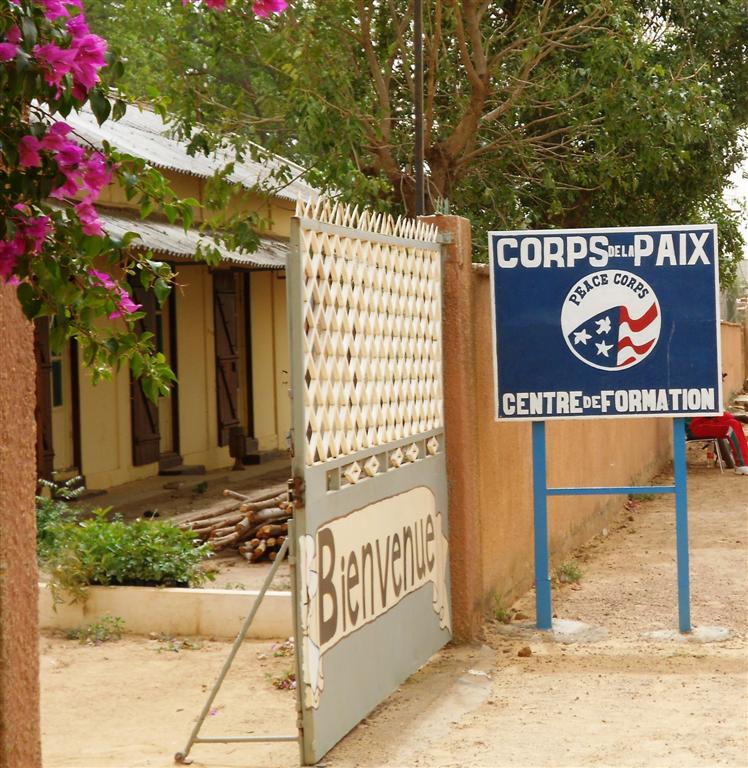
Entrance to the training center