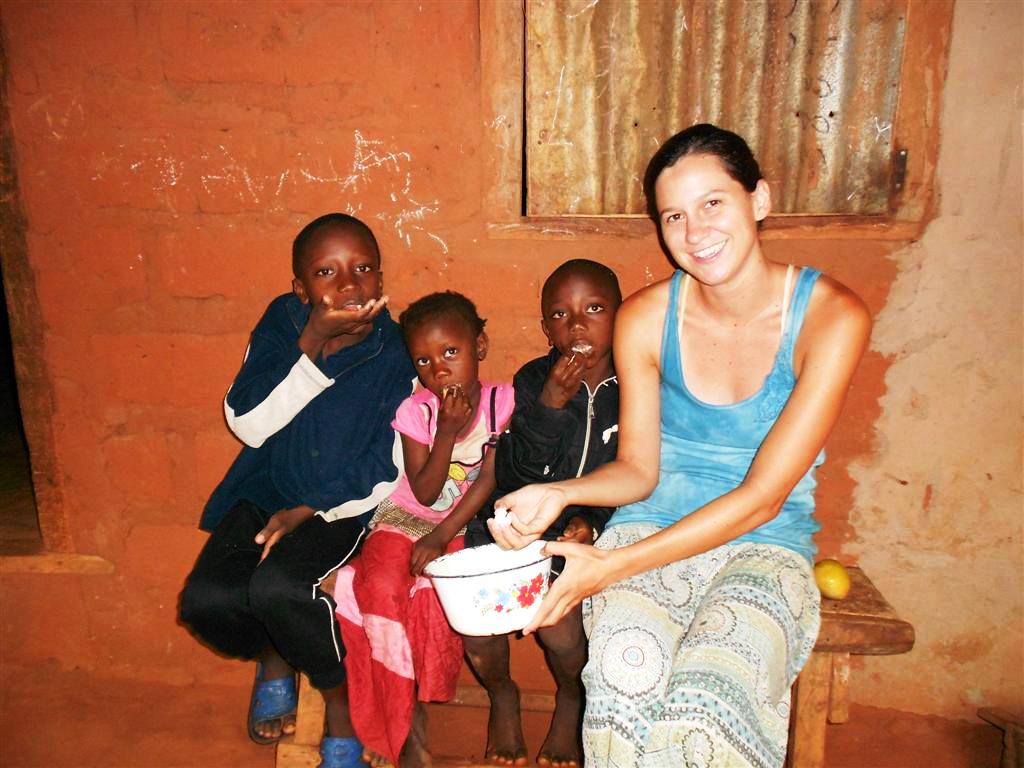
The holiday of Tobaski / Eid is the biggest muslim holiday
celebrated here in the Gambia.
Therefore, the slaughter of millions of rams, goats, sheep, and cows is
accounted for on this one day. Gambians
tell you if you are not eating meat on Tobaski, your holiday is not sweet. This year we had Tobaski in the city in our
new compound. It was very nice and Ben
helped hold the ram while it was being killed and helped Bala, another member
of our compound butcher the ram. I will
spare you the gory pictures. So the
whole day we sat around and had a ram bbq in our compound which was great! We
tried many different parts of the ram that day – liver, kidneys, heart, and
testicles are the ones we could name. Honestly, it wasn’t bad and we’ve eaten a lot
worse here (namely cows foot, ew). In
the evening of Tobaski everyone dresses up in their newest, nicest outfits and
walk around town. This is also the time
when children come around asking for ‘saliboo’.
Saliboo is directly translated to prayers; however the children are
looking for money, not prayers and are quite upset if you only give them a
prayer. Tobaski lasts about 3 days, and
we saw ram in our lunch food bowl for about a week!
Saturday, November 17, 2012
November Update
As our time left in country has started decreasing, so have
our blog entries. I think because we’ve
become busy and also accustomed to life here in Gambia so it makes it hard to
come up with different things to write about.
Ben is still working with IRD; he’s currently working on a cashew
processing manual while the office is in between project phases. He has joined a city football team named
‘Culture’. They are currently in a city
tournament in the first round. Ben goes
to practices and has suited up as a goalkeeper for one game but had an injury
for the game the past weekend so he couldn’t play. The team plays in a big stadium in SerreKunda
so it’s a little different from playing on the village team. Ben didn’t get to play in the game he suited
up for but he was told to start warming up in the middle of the second half and
the crowd started cheering! So again,
he’s making a name for himself as the Toubab goalie in town.
I am now officially a “visiting instructor” at the
University of Gambia. I am co-teaching an Introduction to Agriculture course
with a Gambian lecturer. I will be
teaching this course until the end of the semester, am currently writing the
Agriculture departments catalog, and also writing curriculum for two
environmental science courses that will start next semester. I will also be co-teaching those courses next
semester if the University has enough funding to start the program.
Co-teaching is going really well and I’m glad that I am
co-teaching because the University is different from a University in America. Our class has approximately 45 students and
is considered a large class. There are
often not enough chairs for the students so they spend the first 5 minutes
finding chairs in other rooms. There is
no projector, or dry erase board, only a blackboard, and teachers are not
expected to provide any materials to the students. I type up a hand out each week to go over in
class and after class give it to the students to make copies or share. And I also make use of the blackboard, which
leaves me with chalk flakes all over my clothes! The students are generally very eager to
learn and participate in class which makes it enjoyable and worthwhile. I have also found a group of Gambians who
play beach volleyball every Tuesday and Thursday so I’m having fun doing that
as well!
Monday, October 1, 2012
Change of Scene
Our big news for the past month is that we officially moved out of our village. It was sad, but after Ben’s tie & dye group got disbanded by an NGO, we decided that two Peace Corps volunteers and two NGOs are too much for a village of 200 people. So we asked Peace Corps for a site change, and moved into a new compound in an area called Kanifang. We took over another volunteer’s house after she left in August. We have 3 rooms, a bathroom, kitchen, power, and a TV. It is certainly a change from our village! Packing up and leaving our village went really well. The women had their final tie & dye meeting and gave us some really nice fabric they made with us in Somita. When the Peace Corps car came, all of our neighbors came over and helped us move our things out and said good-bye. It was easier for us to say good-bye because we knew it wasn’t for good and that we’ll come back to visit often before we leave Gambia. It was really nice and our Host Father said a prayer and talked about how we came in peace and are leaving in peace.
Ben started working with an NGO called International Relief & Development (IRD) on their Cashew project. He is working on the Gambia River Basin Cashew Value Chain Enhancement Project. The project promotes local cashew production with farmers and tries to link them with local cashew processors. It is going well for him. I was set up with a teaching position at the University of Gambia; all the necessary procedures were approved, but the University is having problems with the department I will be working with and I haven’t been able to start work yet. Right now, I am keeping busy by working on two manuals for Peace Corps.
We are still settling in to our new place, and it is really different from our previous experience in village. The compound we live in now is very large with four separate houses in it. 2 other volunteers live in the other houses, and our landlord and his family live in a big two-story house in the compound. We eat lunch with the family when we are home. On Fridays we eat a good Gambian dish called ‘benechin’ which is fried rice with vegetables. Our compound benechin is the best we’ve tasted in the Gambia and other volunteers come over to eat it with us when they can. We also have lots of chickens. It’s great, and we are enjoying our last few months that we have left!
Our living room
The compound entrance
hallway to our house
Our landlord sells eggs, and sometimes chicken
Kebba!
Village Olympics
We thought we would not be able to see the majority of the Olympics this year, so we decided to bring the Olympics to Berefet! (As it turned out we got to see a lot of the Olympics, but Berefet Olympics was fun anyhow). The people of Berefet didn’t know what the Olympics were so they were pretty confused, but they had fun with it anyway, especially the children. We had fun going around and getting kids to help us with our little Olympics. Enjoy!
Sana is in lane 4
But failed to make it to the Semi's
Binta did so well on balance beam / water pump style
Samba may be my favorite weight lifter
And its up! Go Samba!
Foday on Javelin
Our shot put Ebrima didn't enjoy the games as much
Donkey equestrian anyone?
Tuesday, July 24, 2012
80 Kilometer Coastline Hike
I joined three girls in an 80 km (50 mile) hike along the whole Gambia Coastline in the beginning of July. It took us about 3 ½ days and although tough on our feet, shoes, and legs, we had a lot of fun. And we got to see the Gambian coastline in its entirety. We finished on the north bank in a national park called Ginak Island. None of us had been there and we stayed with a Peace Corps employee’s family. To get to the island you take a small canoe and it was really pretty. Highlights of the trip included seeing the presidents new mosque which looks like a hotel, meeting a British man who claimed to have been an advisor to the president 20 years ago, seeing a washed up big turtle, the ‘cliffs of Tanji’, being chased by multiple sets of children, and being followed for 6 hours by 2 stray dogs.
Move Cows, get out the way
The Sheraton Gambia wouldn't let us in for some reason...maybe it was the stray dogs following us up to the pool?
Crossing the river to Barra
Coastline
Ginak Island
The start!
A nice village outside Kartong
The Abby's
Our Triumphant Finish
Our feet were not as happy
Rainy Season / Ramadan
We have now reached the time of year in the Gambia where our sahalian, sub-tropical savannah shrubland turns into a tropical forest. And this year is different because it is raining a lot! This is nice because it cools off faster and the rain is a nice change from the hot hot sun. However, with the added rain come added creatures. There are a lot more bugs this year than last year! And you have to be more vigilant where you walk and grab. Last week, I was taking our laundry off the local palm stalk fence and almost grabbed a green snake taking a nap under a pair of Ben’s shorts. I told the old man walking by to be careful, a snake is here. He looked down and quickly decapitated it with the machete he was holding. It was just a common bush snake though, we are lucky not to have seen cobras or puff adders like other volunteers.
It is dead
Samba, our neighbor, helping his Moms collect firewood
We have also just entered the month of Ramadan. Ramadan is nice for us because we get a good meal of noodles, spam, oil, and onions for “break fast” right after sunset. Break Fast is supposed to be really delicious meals, usually with tea. For our village that means noodles and canned meat, and we are not complaining! Neither of us are observing the fast, but we don’t eat or drink in front of anyone in our village during Ramadan.
Shierrifo, Binta, Alpha and me enjoying some rainy day popcorn
USAID Food Security Grant
Back in February, I started working on a USAID food security grant to plant 50 fruit tree seedlings at three schools in our area. One school is our village’s lower basic school and the two other schools are in Ndembang where Jessica lives. The previous month I have been working to make arrangements for this project. Things move slowly here and although we were supposed to receive the money in April, we did not receive approval until June. After approval was granted, it took me another month to actually get the money. By this time, I had a very short amount of time to purchase the seedlings, fencing materials, and get them to the schools before school let out. But we managed, and thus far all the schools have planted the seedlings and protected them. Each school received these types of trees: coconut, Cleopatra mandarin, lime, sweet orange, sweet grapefruit, avodaco, sweet/sour soup, and two different varieties of mangos.
Measuring correct spacing
Bakary planting a sweet orange tree
Head Master, Head Teacher, and Jerreh fencing off a lime tree
The diversity of these trees are not found anywhere else in our area (excluding perhaps an NGO) and will help the schools and community for years to come by increasing nutrition, money, and adding a variety of trees planted in the area. Citrus fruits bring in decent money right now in the Gambia so we made sure to get ample supply of citrus seedlings. All the schools were very happy with the selection and I hope that will aid in the success of maintaining the seedlings.
Tree planting is hard work, but maintenance can be a frequent problem in the Gambia. So I have allocated extra funds to have a completion between the three schools. Kaddy & Fanta’s Tree Competition will give the school with the best orchard 3,000 Dalasi (approximately 100 USD). Students who maintain their tree guards will receive certificates, and students who keep their trees alive will receive a prize. And at each school, the student with the best managed tree will get a prize worth 300 Dalasi (about 10 dollars). Because Jessica (Gambian name – Fanta) is finished with her service and going back to America in August, I will check up on the schools in October, and award prizes in December. The students seem to be excited about it and I hope they will keep up the enthusiasm throughout the next school year.
Jessica/Fanta and Lamin talking business
Coconut trees
Subscribe to:
Posts (Atom)